REVIEW · KATHMANDU
Small-Group Day Tour of Kathmandu
Book on Viator →Operated by Exciting Nepal Treks and Expedition · Bookable on Viator
Four sacred stops, one well-paced day. This small-group Kathmandu tour gives you a fast intro to Nepal’s Hindu and Buddhist landmarks, with expert guidance and minimal time lost in traffic or street haggling. I especially like how it links Pashupatinath and Boudhanath with clear context, so the sights feel connected instead of random. I also like the door-to-door Thamel pickup that keeps your morning simple. One trade-off: the schedule moves, so you’ll want to be comfortable with set time windows at each stop rather than long, slow wandering.
I also appreciate the low-friction planning: hotel transfers, a private vehicle, and a mobile ticket approach that helps you avoid last-minute scramble. With a group capped at no more than 15 people, waiting stays reasonable, which matters in Kathmandu when roads and crowds can change quickly.
In This Review
- Key things that make this Kathmandu day tour work
- Starting in Thamel: Pickup, private car, and a mobile ticket
- Pashupatinath Temple: the pagoda, the linga, and Shiva’s center
- Durbar (Central) Square: power, architecture, and the Malla kings
- Boudhanath Stupa: giant eyes, mandala steps, and trade-route origins
- Swayambhunath Temple: UNESCO views and centuries of restoration
- Time plan and real-life pace in Kathmandu roads
- Price and value: is $165 fair for this day?
- Who this tour fits best
- Should you book this Kathmandu day tour?
- FAQ
- What attractions are included in the small-group day tour?
- How long is the tour and what days does it run?
- Is hotel pickup and drop-off included?
- Are the entry tickets included?
- What’s included in the $165 price, and what’s not?
- Is this tour only for my group, and how big is the group?
- Can I cancel for a full refund?
Key things that make this Kathmandu day tour work
- Small group size (max 15) helps cut downtime between major sites.
- Door-to-door transfers from Thamel remove the stress of coordinating rides.
- Private transport + driver/guide means fewer navigation headaches and more time on foot.
- Four major monuments in 6–7 hours gives you a strong first-day itinerary without burnout.
- Entry fees included for the temple and monastery stops so you can budget more accurately.
Starting in Thamel: Pickup, private car, and a mobile ticket
This tour is built around convenience from the start. If you’re staying in Thamel, you get round-trip pickup and drop-off, so you don’t have to figure out where to meet a stranger or negotiate transport right at the busiest time of day.
The group size matters here. With no more than 15 people, you’re less likely to sit around while everyone buys tickets or re-checks instructions. In practice, that can turn a good day into a great one because Kathmandu timing can be unpredictable, even when everything is planned.
Another practical plus: a mobile ticket is included. That usually means less paperwork and fewer lines. Just do yourself a favor and make sure your phone battery is healthy before you head out, because you’ll rely on that ticket at the sites.
You can also read our reviews of more tours and experiences in Kathmandu.



Pashupatinath Temple: the pagoda, the linga, and Shiva’s center
Your first major stop is Pashupatinath Temple, described as the oldest Hindu temple in Kathmandu, with its existence dating back to 400 BCE (noted with a citation gap in the tour write-up). Even if you don’t chase dates, the place teaches you how Hindu sacred space works: it’s not just architecture, it’s a living religious setting.
The temple’s most important feature for visitors is the sacred linga, the holy symbol of Lord Shiva, set within a richly ornamented pagoda. That visual detail helps you understand what you’re looking at right away. Instead of standing around wondering what matters, you can orient yourself toward the core object of worship.
What I like most at Pashupatinath is how the guide’s explanation turns legends into orientation. The tour notes multiple legends about how Pashupatinath came to be a famous site for Pashupati, Lord of all Pashus. Even if you treat legends as storytelling instead of strict facts, they give you a framework for why people come here and what the symbols mean.
Consideration: this is a top-tier religious site, so it can feel intense and structured. You’ll want to follow the guide’s cues closely about where to stand, when to move, and what to observe.
Durbar (Central) Square: power, architecture, and the Malla kings
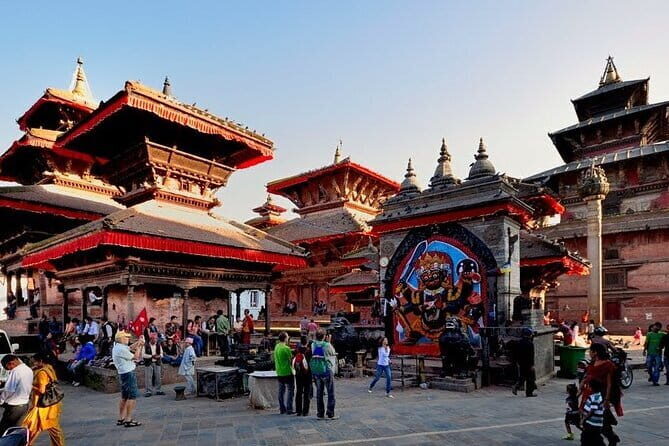
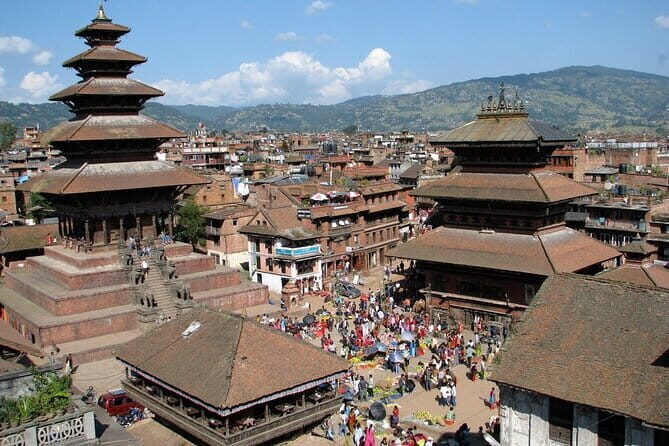
Next up is Durbar (Central) Square, where Kathmandu’s royal past played out. This area is tied to old crossroads activity and local dynasties, but the tour emphasizes the Malla kings’ role in reshaping the square. Most of the architecture you see today dates to the 1600s, especially during the reign of King Siddhi Narsingh Malla and his son (the guide info cuts off after the name, so stick with the idea: the visible buildings largely reflect that era).
Why this stop is worth your time: you’re not just touring “pretty buildings.” Durbar Square is where the royal system left physical fingerprints—palace-like structures, public space, and the way the city organized itself around authority. Even if you’re not a history nerd, this kind of context helps you read Kathmandu streets later.
The tour also points out that the square connects to earlier settlements around the area (including the Pradhanas), and that the history isn’t fully clear in every detail. That honesty is useful. It encourages you to treat Durbar Square as a layered site: parts are ancient, parts are later reconstructions, and the full story isn’t one straight line.
Tip for your mindset: at Durbar Square, keep an eye on the architecture as evidence of time—what looks older, what looks more recent, and how the space is designed for movement and gathering.
Boudhanath Stupa: giant eyes, mandala steps, and trade-route origins
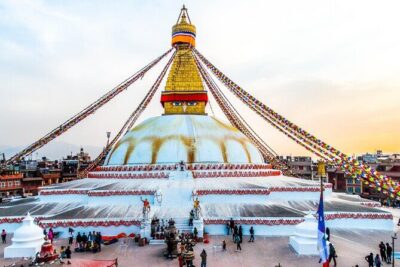
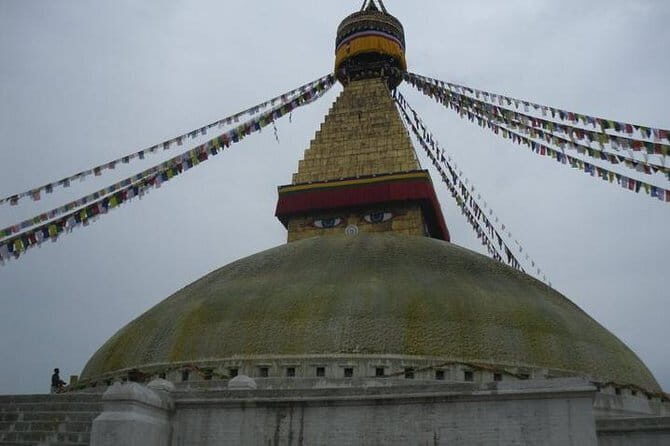
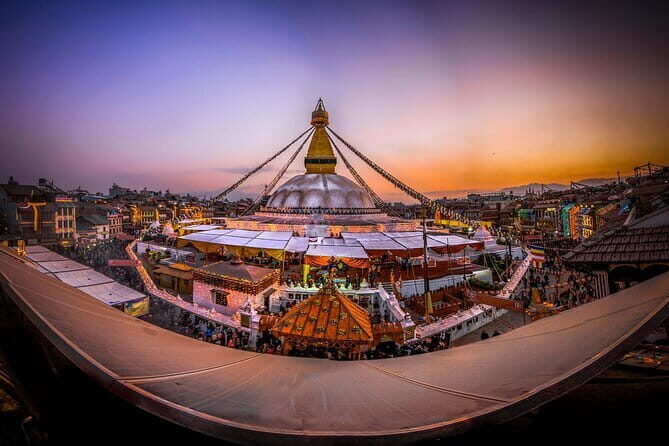
Boudhanath Stupa is one of the most visually unforgettable stops in Kathmandu, and the tour sets expectations well. You’ll see the huge meditative monument towering over the area, with the famous effect of giant eyes—an image people remember long after the day ends.
The tour notes that it was built around the 14th century, and it connects the stupa’s creation to the period shortly after the passing of the Buddha. Again, think of this as tradition and meaning rather than a scientific timeline. What matters for you on-site is how the monument is built to focus devotion: a giant dome with a Buddhist pyramid tower at the top, and huge steps shaped like mandalas.
Another point that makes this stop more than a photo opportunity: the tour mentions the stupa’s original location on an important trade route. That helps explain why big religious sites often sit where people already traveled—faith spreads along pathways that move goods, news, and ideas.
If you’re the type who likes to understand what you’re looking at, this is a great place to slow down mentally even if your schedule stays firm. The guide’s explanations can help you spot how the structure’s parts work together: dome, tower, and stepped mandalas as a single devotional design.
Consideration: this is a major worship center. Be ready for ongoing activity and a steady flow of visitors.
Swayambhunath Temple: UNESCO views and centuries of restoration
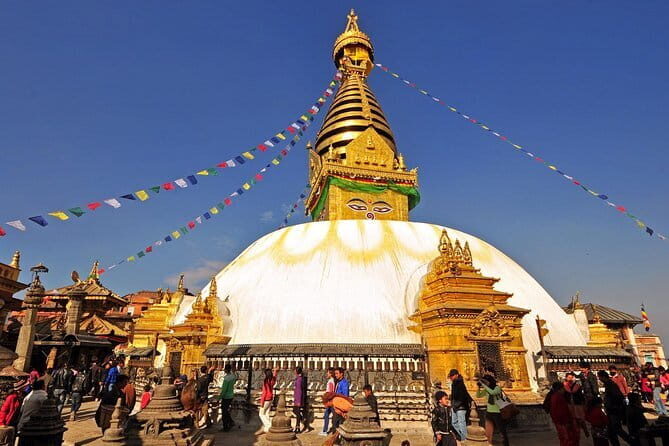
The final religious stop is Swayambhunath Temple, also called Swayambhu. The tour labels it a UNESCO World Heritage Site and gives you a strong timeline to hold onto: the earliest written record noted in the tour materials is a 5th-century stone inscription. That means you can treat this site like a historical anchor, not just an attraction.
The stupa has been restored and repaired multiple times, and the tour highlights key moments of damage and rebuilding:
- In 1349, it was damaged by an invading Muslim army, then later repaired by King Saktimalle Bhalloka.
- In 1505, a yogin named Sangye Gyaltsen added the wheel and spire to the dome.
- In 1614, the 6th Shamarpa built shrines into the stupa in four cardinal directions.
- In 1750, Kagyu lamas held a consecration ceremony after a major renovation.
Those details matter because they explain why sacred sites can look like layered timelines. You’re not seeing one moment frozen in time—you’re seeing changes that different religious leaders and communities built into the same sacred core.
Another reason I like Swayambhunath in a short day: it closes the loop. By the time you arrive here, you’ve seen Hindu and Buddhist sacred space through different architectural styles. That makes it easier to compare: where the focus is placed, how the site communicates meaning, and how devotion shapes the way space is designed.
Consideration: the day ends with this stop, so keep your energy and patience for a strong finish even if the earlier sites took more time than expected.





Time plan and real-life pace in Kathmandu roads
The tour runs about 6 to 7 hours. The visit blocks listed in the itinerary are roughly 1 hour at Pashupatinath, 1 hour 20 minutes at Durbar Square, 1 hour at Boudhanath, and 1 hour 10 minutes at Swayambhunath. In a place where traffic and foot travel can slow you down, that buffer is important.
I’d go into this with one expectation: the tour is designed to reduce waiting, not to maximize your chance to linger everywhere. With a group size of up to 15, you’ll likely move efficiently, but you still need to stay ready for turns in the schedule based on crowds and timing at sacred sites.
Comfort-wise, the private vehicle helps. You’re not bouncing between multiple rides or hunting for directions. That saves energy and reduces the stress of spending the day doing logistics instead of sightseeing.
Also note that the tour is described as private—only your group participates. That’s a good fit if you want consistency in pace and guidance, without being mixed into a big, unpredictable crowd.
Price and value: is $165 fair for this day?
At $165.00 per person, this tour isn’t the cheapest way to see Kathmandu. But it’s also not trying to be. The value is in what’s included.
Here’s what you get for that price, based on the included items:
- Hotel pickup and drop-off (door-to-door from Thamel hotels)
- Transport by private vehicle
- A driver/guide
- Local taxes and a fuel surcharge
- Entry fees included for the temple and monastery stops
- Tickets handled via a mobile ticket approach
The big practical point is that entry fees and guided logistics are part of the cost, not add-ons you pay later. For a first-time day, that can feel like money well spent because it reduces decision fatigue. You’re not doing math at each stop. You’re simply moving through the program.
What’s not included:
- Landing and facility fees
- Food and drinks unless specified
So you’ll still want to plan meals on your own. But you won’t be hit with surprise ticket costs at each monument, which keeps the day cleaner.
My value take: if you’re staying in Thamel and want four major sites with interpretation and minimal waiting, this price is in the right zone. If you’re traveling solo on a tight budget, you might save money by going independently. But you’d also be trading away the time you lose to figuring it out.
Who this tour fits best

This is a strong choice if:
- You’re short on time and want four top Kathmandu sites in one day
- You want a guide who can help you understand what’s special at each location
- You prefer a small group (max 15) instead of big crowds
- You’d rather avoid the taxi and rickshaw negotiation hassle in central Kathmandu
It may be less ideal if:
- You dislike structured schedules and prefer long, quiet stays at fewer places
- You want total flexibility to change stops on the fly
- You’re very sensitive to the pace of a day tour in a city where things can run slower than expected
One more note from guide feedback patterns: guides like Raju are described as speaking very good English and providing historical background. Other staff names that appear include Drubha and Subash. That’s a good sign for communication, especially if you want more than surface-level facts.
Should you book this Kathmandu day tour?
I’d book it if you want a clear, guided first day that covers major religious landmarks without turning your day into transportation chores. The Thamel pickup, private vehicle, and entry fees included are the real advantages, because they remove friction and let you focus on the sites.
Skip it only if you’re planning to move at your own rhythm and you don’t care about guided context. In that case, independence can be cheaper. For most first-timers, though, this is a tidy way to get oriented quickly and leave Kathmandu with better understanding than you started with.
FAQ
What attractions are included in the small-group day tour?
The tour covers four major sites: Pashupatinath Temple, Durbar (Central) Square, Boudhanath Stupa, and Swayambhunath Temple.
How long is the tour and what days does it run?
The duration is approximately 6 to 7 hours. It runs Monday through Saturday, within the listed opening hours (12:15 AM to 11:45 PM) during the listed operating period.
Is hotel pickup and drop-off included?
Yes. The tour includes door-to-door round-trip transfers from Thamel hotels.
Are the entry tickets included?
Yes. Entry fees for the temple and monastery are included, and the itinerary lists admission tickets included at each stop.
What’s included in the $165 price, and what’s not?
Included items are local taxes, transport by private vehicle, driver/guide, hotel pickup and drop-off, fuel surcharge, and entry fees for the temple and monastery. Not included are landing and facility fees, and food and drinks unless specified.
Is this tour only for my group, and how big is the group?
It is described as a private tour/activity, meaning only your group participates. The format also specifies a small group with no more than 15 people.
Can I cancel for a full refund?
Yes. There is free cancellation, with a full refund available if you cancel at least 24 hours in advance of the experience’s start time.