REVIEW · KATHMANDU
UNESCO Five World Heritage Tour in Kathmandu
Book on Viator →Operated by Himalayan Advisor Pvt. Ltd. · Bookable on Viator
Nine stops, five UNESCO areas, one tight day. This private Kathmandu circuit is a smart way to see the big spiritual and royal landmarks—Swayambhunath, Kathmandu Durbar Square, Patan’s royal core, Pashupatinath, and Boudhanath—without wasting time chasing transport or tickets.
I especially like two things: first, the plan includes hotel pickup and drop-off inside the Ring Road area (including Bouddha), which saves you from guesswork; second, you’re with a professional guide who can explain what you’re looking at while you’re actually there—so sites like Kumari Chowk and the temples in Patan make more sense fast. The main drawback is that it’s a long, packed 7–8 hour run, and there’s no food included, so you’ll want to plan ahead for energy.
In This Review
- Key highlights I’d prioritize
- Why Kathmandu’s UNESCO mix fits a short visit
- Pickup inside the Ring Road: your easiest win
- Swayambhunath: where two faiths share the hill
- Amidevi Buddha Park: a short, beautiful breather
- Kathmandu Durbar Square: royal space under restoration
- Basantapur Tower and Taleju Temple: look up, then look closer
- Kumari Chowk and Kaal Bhairab: beliefs you can point to
- Patan Royal Palace area: royal power and craft
- Patan Durbar Square: Newari architecture at street level
- Patan Museum and Golden Temple: details that reward time
- More Patan temples: Vishwanath and Bhimsen for variety
- Pashupatinath: a huge Shiva complex and a full hour
- Boudhanath: prayer wheels and the 36-meter stupa
- Price and value: why $130 can make sense here
- Who this tour is best for (and who should slow down)
- Should you book this UNESCO Kathmandu day tour?
- FAQ
- What time does the tour start?
- How long is the tour?
- Which UNESCO sites are included?
- What’s included in the tour price?
- Is food included?
- Do you pick up from hotels?
- Is this tour private?
- How far in advance is this typically booked?
- What if my plans change—can I get a refund?
Key highlights I’d prioritize
- Hotel transfers inside the Ring Road (including Bouddha area): less stress, fewer logistics moments.
- Entry fees included: you can focus on photos and questions instead of payment lines.
- A private format for your group: no waiting for strangers to catch up.
- Durbar Square stops at multiple “depth levels”: towers, temples, courtyards, and statues all in one flow.
- Patan Royal Palace + Patan Durbar Square in the same day: Newari architecture and craft details at an efficient pace.
- Buddhist and Hindu sites paired across the valley: Swayambhunath and Boudhanath on one side; Pashupatinath on the other.
Why Kathmandu’s UNESCO mix fits a short visit
If you only have one full day in Kathmandu, this tour is built for that reality: you trade wandering for structure. You get a single route that connects major UNESCO-listed landmarks across the Kathmandu Valley, plus extra stops inside those major complexes. That matters because Kathmandu heritage isn’t just one building—it’s layered spaces: squares, courtyards, stupa steps, temple compounds, and surrounding neighborhoods.
I also like the balance here. The tour intentionally pairs places where Buddhism and Hinduism are both visibly present. For example, Swayambhunath is described as holy ground important to both Buddhist and Hindu communities, and Pashupatinath is laid out as a major Shiva-centered temple complex. That pairing turns your day into a bigger story, not just a checklist.
One practical note: the day is long enough that your “comfort strategy” matters. Think water, snacks, and taking a few slow breaths inside the busiest squares. No food is provided, so you’ll want to bring or budget for something outside the tour.
You can also read our reviews of more historical tours in Kathmandu

Pickup inside the Ring Road: your easiest win
The biggest day-saving feature isn’t glamorous, but it works: the tour includes hotel pickup and drop-off within the Ring Road area, including the Bouddha area. Kathmandu traffic can be unpredictable, so being picked up near your lodging (rather than trekking across town to a meeting point) keeps the morning from getting chaotic.
Start time is 9:00 am, and the tour runs about 7–8 hours. That timing is useful because you’re going early enough to beat some of the crowd pressure around the major squares and stupa zones. Still, expect walking. Durbar Square areas and stupa approaches involve stairs and compact paths, especially when you’re moving as a group.
Because it’s a private tour for your group only, you’re not trapped behind a large shared schedule. That said, “private” doesn’t mean “slow.” The route is designed to hit many stops, so you’ll be moving throughout the day.
Swayambhunath: where two faiths share the hill
Stop 1 is Swayambhunath, a UNESCO World Heritage Site and one of the first places you visit today. The tour framing is clear: this stupa is important to both Buddhist and Hindu communities. That blend is the point. As you arrive, you’ll see the site’s role as more than a single-faith landmark.
You’ll spend about 1 hour here, which is just long enough to do two useful things: (1) get your bearings on the stupa and surrounding areas, and (2) listen to the guide’s commentary while you’re standing in the exact spaces they’re describing. If you like architecture and symbolism, Swayambhunath is a strong opener because it sets up the cultural theme for the rest of the day.
A quick practical consideration: the stupa hill can feel busy, so wear shoes you’re happy to walk in for a while. This is the kind of stop where you’ll want to take breaks without stopping the whole group’s momentum.
Amidevi Buddha Park: a short, beautiful breather
Right near Swayambhunath’s hill is Amidevi Buddha Park, your second stop. You get only 15 minutes, but that’s intentional: it’s a quick pause near the main action.
The highlight here is simple and visual: the park has three large statues of Shakyamuni Buddha. This short stop is ideal for travelers who want a calmer moment between bigger, more ceremonial places. It’s also a good place to refocus your attention after Durbar Square crowds later in the day.
If you’re the type who likes details, use the time to look at how the statues are positioned in the park space, not just at the statues themselves. A 15-minute window can still be meaningful if you slow down for half of it.
Kathmandu Durbar Square: royal space under restoration
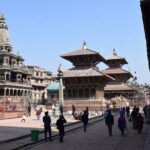
Stop 3 is Kathmandu Durbar Square, a royal square in the Kathmandu Valley filled with historic and religious sites and architectural structures. The tour notes that many structures are being reconstructed, which is important context. You’re not just seeing old stones—you’re seeing a living heritage area, still changing as it’s preserved.
You’ll have about 1 hour here, and that’s your chance to understand how Durbar Squares function: they’re both civic spaces and sacred landscapes. In other words, they’re not only for worship—they’re also places where power, craftsmanship, and community identity show up in the built environment.
A small drawback to consider: reconstruction and renovation mean your view might be partly blocked in spots. That doesn’t ruin the experience; it just means your photos might be “in progress.” Go in expecting that.





Basantapur Tower and Taleju Temple: look up, then look closer
Within Kathmandu Durbar Square, the tour includes several focused stops:
- Stop 4: Basantapur Tower (30 minutes). The tower is described as one of the attractive places to visit in Durbar Square. This is one of your “get the shape of the place” moments—good for understanding how the space is arranged vertically as well as horizontally.
- Stop 5: Degu Taleju Temple (10 minutes). This temple is noted as being built in 1564, which makes the stop more than a quick glance. If you’re into dates and dynastic timeframes, the guide commentary here should help you connect the temple to the larger square.
- Stop 6: Kumari Chowk (10 minutes). The courtyard is tied to a tradition of the Kumari, a living goddess selected until puberty and then becomes a mere mortal. This is one of those stops where the meaning is as important as the architecture.
And then two ultra-short, meaning-heavy stops:
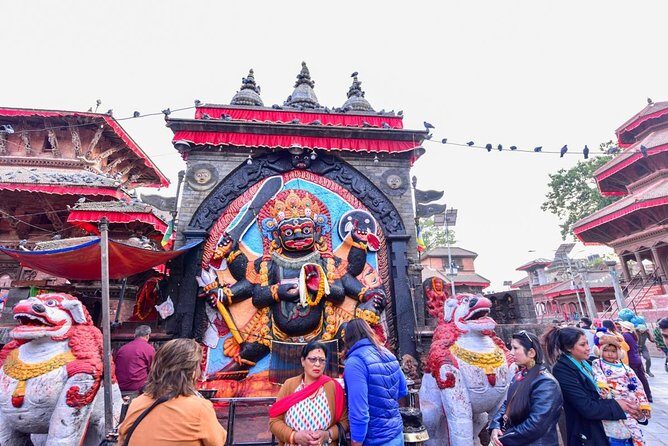
- Stop 7: Kaal Bhairab (5 minutes). You’ll see the statue of Bhairav in Kathmandu Durbar Square. Even in five minutes, a guide can make this land if they explain the role Bhairav has in local religious life.
- Stop 8: (You’ll transition out of the Durbar zone toward Patan next.) The pacing keeps the day moving while still giving enough time for the major “story anchors.”
If you like learning by asking questions, these clustered stops are a gift. You can keep asking the guide why certain places matter and watch the answers connect across the square.
Kumari Chowk and Kaal Bhairab: beliefs you can point to
Kumari Chowk is short on the clock but big on cultural weight. The tour’s description frames the tradition in clear, practical terms: a girl selected as a living goddess until puberty. That gives you a concrete way to think about what you’re seeing—not just symbols, but a human tradition tied to time.
Then comes Kaal Bhairab, the statue stop. In five minutes, it’s easy to treat it like a quick photo moment. Don’t. Use the time to notice how religious identity is expressed through statues in Durbar Square.
Here’s the balance: this part of the day can feel fast, but the pay-off is that you leave the square with a sharper sense of how multiple belief layers overlap in one civic space.
Patan Royal Palace area: royal power and craft
Next you head to Patan, starting with Stop 8: Patan Royal Palace (1 hour). The tour describes it as one of the oldest royal palaces of Patan, and it names key landmarks in the surrounding complex area, including Krishna Temple, Tulaja Devi Temples, and the Patan Museum, plus a mention of a Golden element (handled more specifically at the Golden Temple stop later).
This hour is your biggest Patan chunk, and it works well because Patan’s identity is strongly tied to Newari architecture and craftsmanship. If you care about how architecture reflects social structure, you’ll probably enjoy this segment.
Practical tip: in Patan zones, you may notice the flow of foot traffic is different from Kathmandu Durbar Square. Being with a guide helps you move efficiently and understand what you’re skipping.
Patan Durbar Square: Newari architecture at street level
Stop 9: Patan Durbar Square (45 minutes) shifts your focus from palace complex to royal courtyard spaces. The tour description calls it the adobe for Newari architecture, highlighting temples and artistic creations established by the Newar community.
This stop is worth your attention because Newar architecture tends to reward slow looking: windows, carvings, and temple forms can take time to register. With only 45 minutes, you won’t see everything—but you can still come away with a strong sense of the style and its religious function.
Stop 10: Taleju Mandir Temple (15 minutes) is also included, described as rebuilt by Srinivasa Malla after a fire in 1676. That detail helps you see the temple as part of an ongoing repair and renewal story—not just a snapshot from the past.
Patan Museum and Golden Temple: details that reward time
Two of the most satisfying short stops happen in this stretch:
- Stop 11: Patan Museum (15 minutes). The museum is described as worth visiting, with old statues and carved windows and wooden pillar details. This is a great “reset stop” during a busy day. Even if you don’t stay long, you’ll likely enjoy how the museum context gives your eyes something specific to look for back in the square areas.
- Stop 12: Golden Temple (Hiranya Varna Mahavihar) (10 minutes). This one is described as a 12th-century temple with bronze statues, covered in silver and golden decorations, and a pagoda-style design with a golden image of Lord Buddha.
Ten minutes sounds quick, but for a building like this, it can be enough to see the main visual impact and then move on. The guide commentary is what turns a short visit into something memorable.
More Patan temples: Vishwanath and Bhimsen for variety
After the Golden Temple, the route adds two smaller temple stops that change the texture of your day:
- Stop 13: Vishwanath Mandir Temple (5 minutes). Built during the reign of Siddhi Narsingh Malla and dedicated to God Shiva. Even a five-minute stop can work well if you’re thinking historically and religiously, not just taking photos.
- Stop 14: Bhimsen Temple (15 minutes). Built in 1680 by Srinivasa Malla and worshiped by the Newar community as a god of business and trade.
That “god of business and trade” detail is a nice reminder that temples aren’t only about rituals. They also connect religious life to daily work and community identity.
If you’re the type who enjoys asking questions, this is another place where your guide can make the short stops feel meaningful instead of rushed.
Pashupatinath: a huge Shiva complex and a full hour
Stop 15 is Pashupatinath Temple, a Hindu temple complex with over 500 shrines and temples. The tour description calls it the main temple for Shiva devotees and notes the entry to the complex reveals many pagoda structures.
You’ll spend 1 hour here. This isn’t a quick stop. It’s long enough to take in the scale of the compound and understand why it’s one of the anchors of Hindu pilgrimage culture in Kathmandu Valley.
Practical consideration: places with many shrines can overwhelm your senses. Use the hour to focus on the guide’s key points rather than trying to “see everything.” One strong, explained perspective will beat 60 minutes of random wandering.
Boudhanath: prayer wheels and the 36-meter stupa
Finally, Stop 16: Boudhanath Stupa (1 hour) closes the day with Buddhism’s visual power. The tour description states this stupa is a 36 meters high dome-shaped structure, surrounded by many prayer wheels and picture carvings of Buddha.
This is the other major contrast stop after Pashupatinath. If you want your day to feel like a conversation between faith traditions, finishing here makes sense. The stupa’s scale and the repeated prayer wheel design gives your eyes something rhythmic to follow.
Also: one hour here is a good amount of time. You can watch movement, let the atmosphere settle, and still have time to ask your guide what you’re noticing.
Price and value: why $130 can make sense here
At $130 per person, the value is strongest if you compare it to the cost of solving Kathmandu logistics on your own.
What you’re paying for includes:
- Transport by private car
- Professional tour guide
- Entry fees for all heritage sites
- Hotel pickup and drop-off inside the Ring Road area (including Bouddha)
When entry fees are included, you avoid one annoying part of independent touring: multiple small payments at multiple sites that can eat your day’s flow. And because the route is private for your group, you aren’t waiting on a large shared itinerary.
The trade-off is time. This isn’t a leisurely day. It’s a packed itinerary designed for people who want the most major UNESCO areas in one go.
Who this tour is best for (and who should slow down)
This tour fits best if you:
- Want culture, history, and architecture in one structured day
- Have limited time in Kathmandu and want the big sites connected logically
- Like learning with a guide as you walk—especially when sites have layered meaning like Kumari Chowk and Bhimsen Temple
- Prefer planning that covers transport and entry fees, so you don’t spend your morning bargaining for taxis
You might want a different pace if you:
- Hate long days with lots of “move, look, move again”
- Need frequent food breaks (because food and drinks aren’t included)
Should you book this UNESCO Kathmandu day tour?
Yes, I think you should book if you want an efficient, organized way to see the valley’s core UNESCO landmarks—without juggling transport, paying multiple entry fees, or guessing where to go next. The guide-driven explanation (with guides such as Shanti, Sarita, Shanthi, Tej, and Rabina described in the operator’s experience) is a big part of the payoff, because several stops here are short but meaningful.
If you’re excited by temples, squares, and the visible mix of Buddhist and Hindu traditions, this is exactly the kind of day that makes Kathmandu click.
FAQ
What time does the tour start?
The tour start time is 9:00 am.
How long is the tour?
Plan for about 7 to 8 hours.
Which UNESCO sites are included?
The route covers UNESCO World Heritage sites including Swayambhunath, Kathmandu Durbar Square, Patan Durbar Square, Pashupatinath, and Boudhanath.
What’s included in the tour price?
The price includes private car transport, entry fees for the heritage sites, a professional tour guide, and hotel pickup and drop-off within the Ring Road area (including Bouddha area).
Is food included?
No. Food and drinks are not included.
Do you pick up from hotels?
Yes, pickup and drop-off are included for hotels within the Ring Road area, including the Bouddha area.
Is this tour private?
Yes. It’s described as private, with only your group participating.
How far in advance is this typically booked?
On average, it’s booked about 55 days in advance.
What if my plans change—can I get a refund?
Free cancellation is available. You can cancel up to 24 hours in advance for a full refund, and within 24 hours there’s no refund.